
Why did the fire horn sound in Cowdenbeath?
When Lochgelly’s Co-op caught fire, the local crew had their hoses ready. The town’s water supply had been turned off for the night.
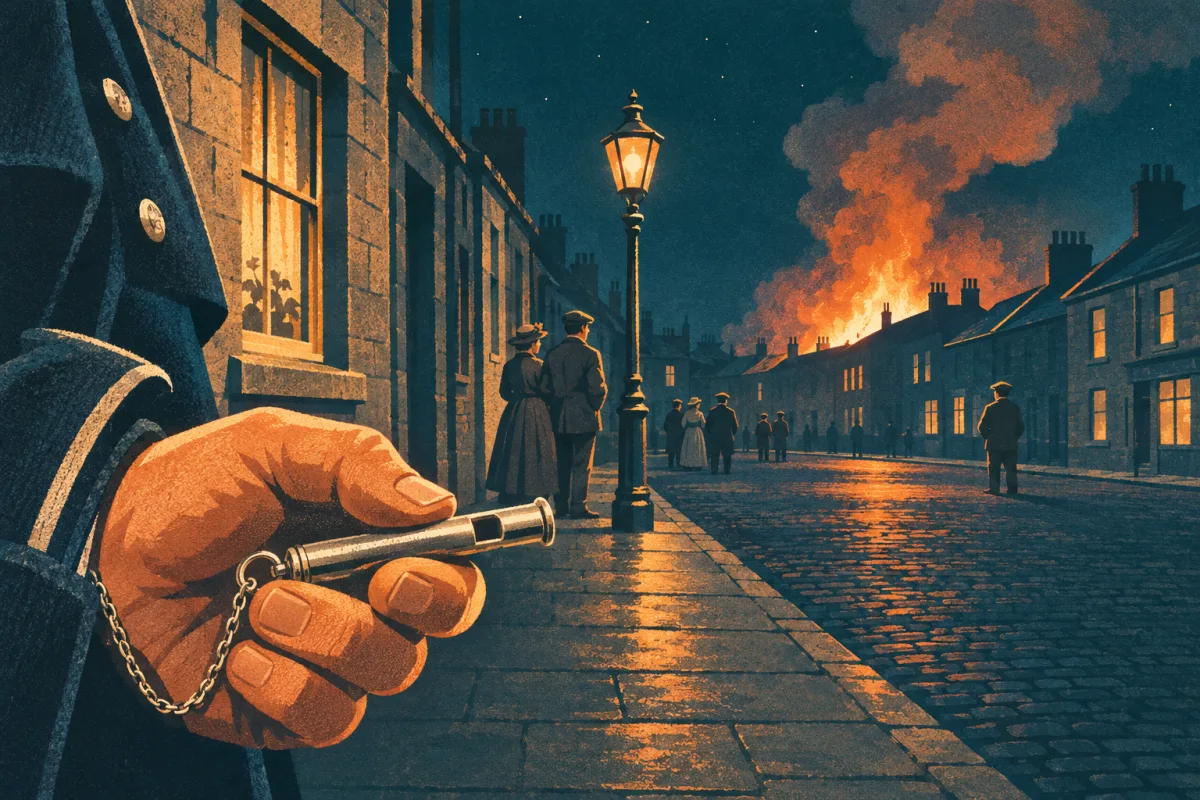
August 1913
Lochgelly’s town clerk had telephoned for help. The Co-op on Bank Street was burning, and the horn called out Cowdenbeath’s brigade. A crowd followed the engine to Lochgelly.
Read the 1913 newspaper reportConstable Mitchell blew his whistle at about two o’clock one August morning in 1913. He had spotted a fire in the Co-op’s grocery cellar on Bank Street in Lochgelly. Alex Love, a baker making an early start, saw it too and raised the alarm. The town clerk telephoned Cowdenbeath and Buckhaven for help. In Cowdenbeath the fire horn woke people in their beds. A crowd followed the brigade’s new engine along the road to Lochgelly.
Water from the Jenny Gray Pit?
Lochgelly’s crew had their hoses out. For two months a water shortage had meant turning off the town’s supply at night. A quarter of an hour passed before the water came on. The engines could pump it high enough to reach the fire, but the Lochore reservoirs were low. The crews considered drawing water from the Jenny Gray Pit. The extra hose sent from Dunfermline proved unsuitable.
At twenty past three the shop clock stopped. By that afternoon the Co-op was selling groceries again, from the Drill Hall. The listing for the old store at the corner of Bank Street and Chapel Street describes three clock faces around its narrow round tower, with a lead-covered dome above them.
From a handcart to a Leyland
David Hardie, Cowdenbeath’s burgh chamberlain, remembered when the crew wheeled their hose to a fire on a two-wheeled barrow. A steam engine came next. The trouble, he told the Rotary Club, was getting it to the fire. In 1923 the council agreed to buy a motor engine. By the time Hardie spoke in February 1924, the brigade had its new Leyland.
The fire in the local record
- “Huge Fire in Lochgelly”, Cowdenbeath & Lochgelly Times & Advertiser, 3 September 1913. Jim Campbell transcribed the report in A Wee Keek Back, pp. 99–101.
- Historic Environment Scotland’s description of the Bank Street and Chapel Street Co-op.
- The 1923 decision to buy a motor engine and David Hardie’s account of the brigade’s equipment, 20 February 1924, also in Campbell’s collection.